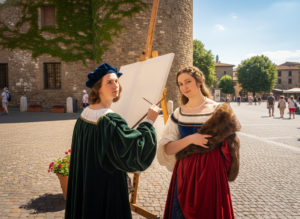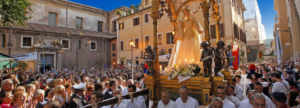

The Basilica of Santa Maria in Trastevere is the first church in Rome officially dedicated to the Virgin Mary, founded in 340 AD and rebuilt in 1140 with Byzantine mosaics that rival Ravenna’s masterpieces. Unlike the Vatican’s overwhelming crowds, this basilica offers intimate access to 12th-century art in a neighborhood that functions as a living Roman community rather than a tourism zone. Continue with our guides to what to do in Trastevere, the Raphael and Fornarina legend, and the Festa de Noantri.
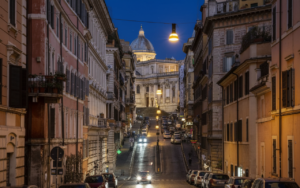
For travelers planning Rome itineraries, this church solves a specific problem: how to experience world-class sacred art without fighting through security lines and tour groups. The basilica sits in Trastevere, a district where locals still outnumber visitors, where the piazza transforms from morning espresso hub to evening gathering spot, and where the golden facade illumination at sunset creates one of Rome’s most memorable scenes.
What Makes This Church Different from St. Peter’s or Santa Maria Maggiore?
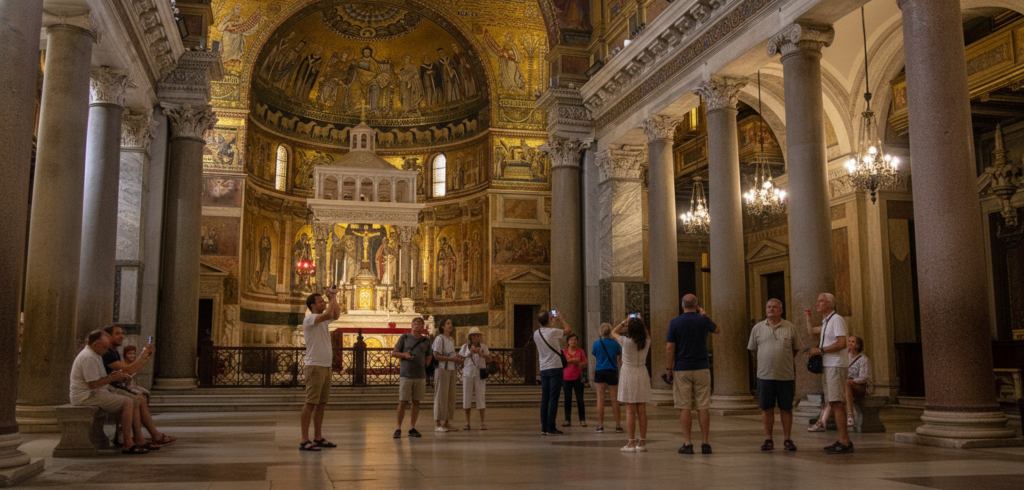
The basilica preserves its medieval character because it escaped Baroque renovations that transformed most Roman churches. While St. Peter’s was completely rebuilt in the 16th century and Santa Maria Maggiore received heavy Baroque additions, Trastevere Santa Maria retains its 12th-century structure, mosaics, and Cosmati floor virtually intact.
- The apse mosaic shows Christ and Mary seated as equals on a shared throne—a radical artistic statement for 1140. Christ’s arm rests around Mary’s shoulders, and both wear crowns. The Latin inscription reads “Come, my chosen one, and I will place you on my throne.” This iconography emphasizes Mary’s role as co-redemptrix, a theological position debated throughout medieval Christianity.
- Below the apse, six mosaic panels by Pietro Cavallini (1291) depict scenes from Mary’s life. These mosaics mark a turning point in Western art. Look at the Nativity panel: Mary reclines on an actual bed with realistic drapery folds. The Annunciation shows genuine emotion on Mary’s face—surprise, contemplation, acceptance. This naturalism predates Giotto’s revolutionary frescoes in Padua by 15 years.
- The church uses 22 ancient Roman columns salvaged from the Baths of Caracalla. Each column is slightly different—some Ionic, some Corinthian—creating visual variety that pure architectural symmetry would lack. The Cosmati floor, a geometric pattern of colored marble, has been walked on for 800 years. No two sections repeat exactly.
How Did a Working-Class Neighborhood Get Rome’s Finest Mosaics?
Trastevere means “across the Tiber.” In ancient Rome, this district housed immigrants, dock workers, and a large Jewish community. According to tradition, a miraculous spring of oil erupted here in 38 BC, which early Christians interpreted as a prophecy of Christ’s coming.
Pope Callixtus I established a house church here around 220 AD, making it one of Christianity’s earliest worship sites. When Pope Innocent II rebuilt the church in 1140, he faced a political problem. He had just returned from exile after a contested papal election. He needed to demonstrate legitimacy and power.
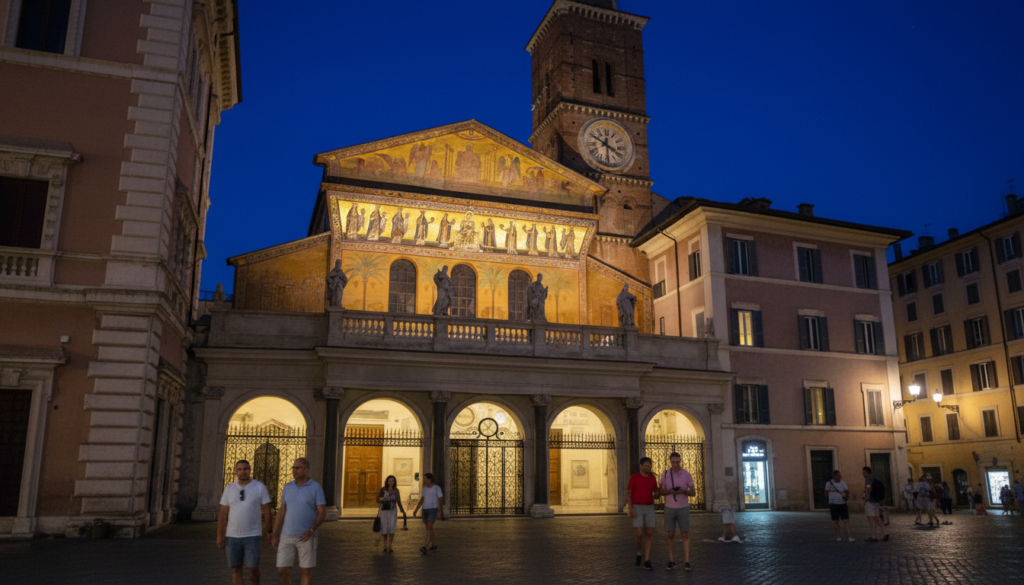
His solution: commission the most spectacular Byzantine mosaics in Rome. He imported craftsmen who knew techniques nearly lost in the West—how to set gold glass tesserae at angles that catch candlelight, how to calculate perspective on curved apse surfaces, how to create images that shimmer rather than sit flat.
The engineering challenge was substantial. Each gold tessera contains actual gold leaf sandwiched between glass layers. The bottom layer curves slightly, amplifying reflection. When you set thousands of these at varying angles on a curved surface, light bounces in multiple directions simultaneously. Think of a disco ball: each mirror facet catches light differently. The cumulative effect creates movement and depth that flat painting cannot achieve.
The tradeoff: This technique required extraordinary expense and time. A single square meter could take weeks and cost as much as a small house. This is why mosaic work declined after the medieval period—fresco painting achieved similar visual impact at one-tenth the cost. But frescoes fade and flake. These mosaics, after 900 years, still glow.
What Should You Look For in the Interior?
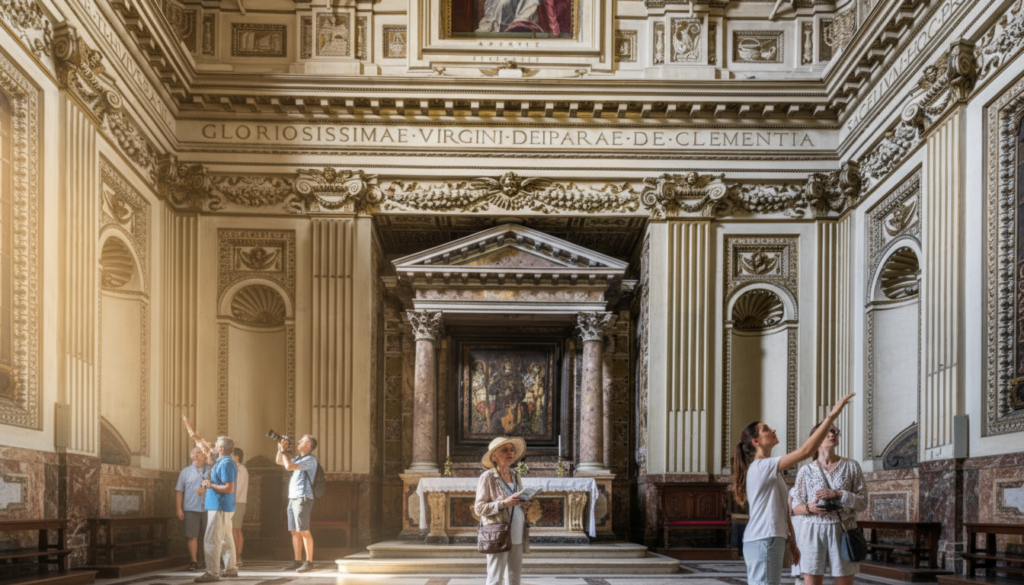
The Altemps Chapel, left of the altar, contains a 6th-century icon called “Madonna della Clemenza.” This is one of the oldest Marian icons in existence. The face appears almost black—not original pigment, but centuries of candle smoke and oxidized varnish. Conservators deliberately preserve this patina because it represents the icon’s lived history.
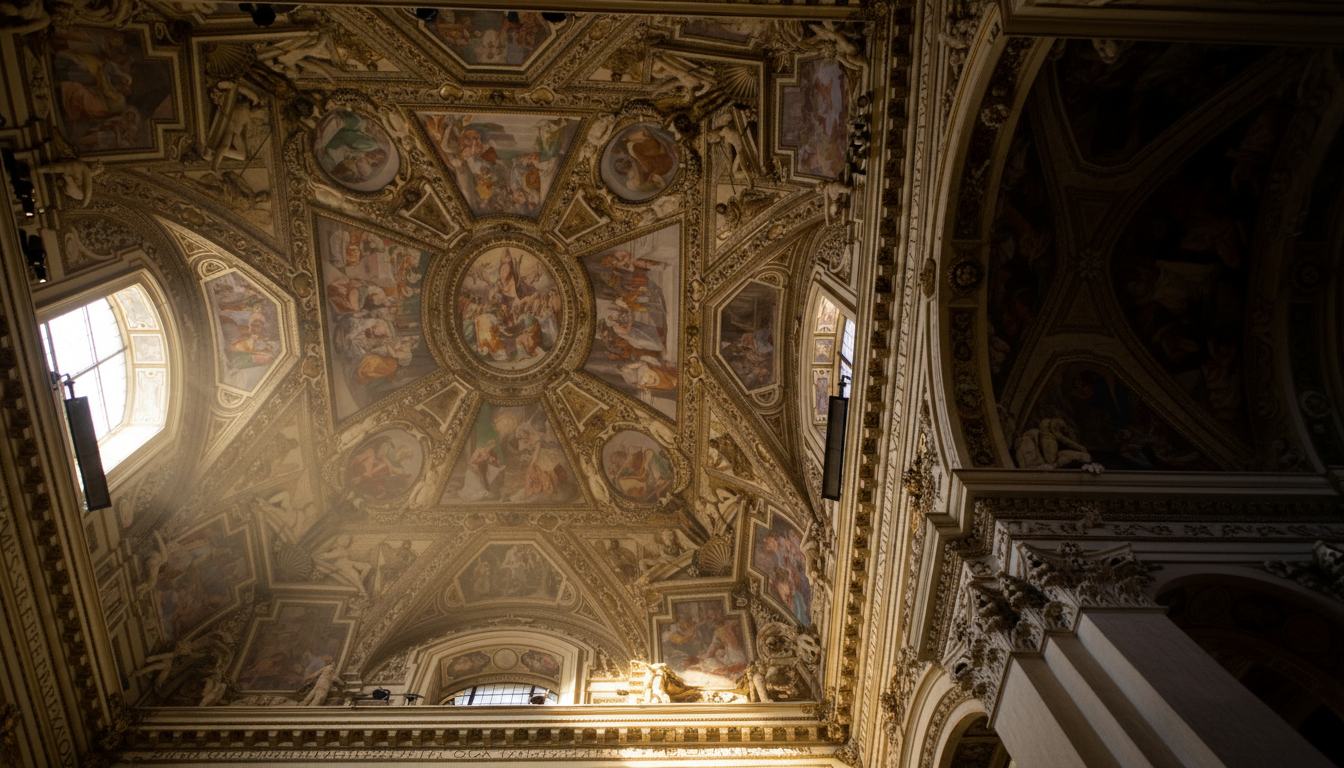
The wooden ceiling (1617) features an octagonal design with a central Assumption painting. This was a compromise addition. Baroque patrons wanted to “update” the church, but the community resisted major changes. The ceiling satisfied reformers while leaving the medieval walls untouched.
Study the Cavallini mosaics closely. In the Presentation at the Temple, notice how the figures occupy actual architectural space rather than floating on a gold background. In the Dormition of the Virgin, the apostles show individual facial expressions—grief, shock, contemplation. This psychological realism was revolutionary for 1291.
Visit between 3-5 PM on sunny days. Western light hits the apse at an angle that makes the gold tesserae ignite. The medieval craftsmen calculated this effect precisely. You’re seeing the mosaics exactly as they intended—not as museum pieces under artificial light, but as living elements responding to natural illumination cycles.
When Should You Visit to Avoid Crowds? (Opening Hours and Mass Schedule)
The basilica opens daily 7:30 AM to 9 PM, with a midday closure 12:30-3 PM in winter. Mass times: 8 AM weekdays, 10 AM Sundays (English available), 7 PM evenings.
- Arrive at 7:30 AM for solitude. You’ll have 30-45 minutes before tour groups arrive. Morning light through clerestory windows creates dramatic shadows across the ancient columns.
- Avoid Sunday mornings unless attending Mass. The church is filled with parishioners, and wandering during services is disrespectful.
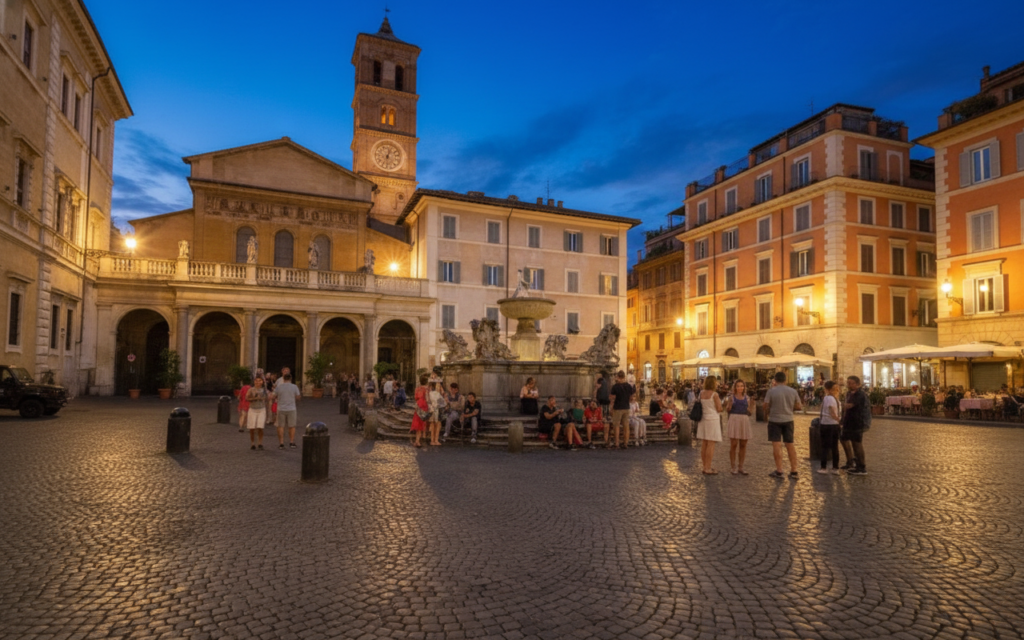
- The piazza transforms throughout the day. Morning brings locals grabbing espresso. Afternoon sees artists sketching the octagonal fountain. Evening turns the square into an outdoor living room.
What Else Should You See in Trastevere? (Including San Crisogono)
- Villa Farnesina, five minutes north, contains Raphael frescoes in a Renaissance banker’s villa. It costs €10 and is rarely crowded.
- San Crisogono in Trastevere, a nearby Romanesque church, offers free entry and features an ancient early Christian basilica beneath its floor—accessible through excavations.
- Botanical Gardens (Orto Botanico) offer 12 hectares with 3,000 plant species. Entry costs €4.
- For food, avoid restaurants directly on Piazza di Santa Maria. Walk two blocks to Da Enzo al 29 for traditional Roman cuisine. Suppli Roma serves the neighborhood’s best fried rice balls. Biscottificio Artigiano Innocenti has made cookies since 1929.
The Three Mistakes That Ruin Most Visits
- Mistake 1: Rushing through in 10 minutes. Visitors snap a photo of the apse and leave, missing the Cavallini mosaics entirely—they’re lower on the wall and require moving closer to the altar.
- Mistake 2: Photographing instead of observing. Visitors spend entire visits looking through phone screens. Smartphone cameras can’t handle the contrast between bright gold and dark surroundings. You’ll get a blurry, washed-out image.
- Mistake 3: Visiting only the church and skipping the neighborhood. The basilica isn’t a museum piece; it’s the spiritual center of a community. Seeing locals light candles or elderly women praying connects you to that continuity.
After visiting the basilica, walk to the piazza’s back corner and examine building facades. You’ll see medieval tower houses, Renaissance palaces, and 19th-century apartments layered together. This architectural palimpsest is the real story of Rome.
Planning Your Visit: A Practical Timeline
For a complete Trastevere experience, allocate 3-4 hours:
- 3:00 PM: Arrive at the basilica when afternoon light hits the mosaics. Spend 45 minutes inside.
- 4:00 PM: Explore the piazza and octagonal fountain.
- 4:30 PM: Walk north to Villa Farnesina to see the Raphael frescoes.
- 6:30 PM: Return for aperitivo. Grab a table at Ombre Rosse or Bar San Calisto.
- 8:00 PM: Dinner at Da Enzo al 29 (reserve ahead).
- Post-Dinner: Return to the piazza to see the facade illumination. The golden mosaic glows against the dark sky.